Clinical Trial Prescreening vs. Screening: What's the Difference?
Direct answer
Preliminary prescreening is an early, site-approved process for collecting candidate-reported information, identifying apparent mismatches or missing items, and preparing an organized record for site review. Formal screening is where the research site applies protocol requirements, performs protocol-defined procedures, and uses clinical judgment to determine eligibility.
Consent2Randomize can support the preliminary operational process. It does not perform formal clinical screening or determine eligibility.
Terminology varies by protocol and site. In this article, “preliminary prescreening” means nonclinical, site-approved information collection and open-item handling before formal site screening. The exact workflow depends on:
- The protocol
- Site procedures
- IRB requirements
- Privacy and authorization requirements
- Applicable regulations
- The information or procedure involved

Why the Distinction Matters
A clear boundary keeps preliminary information collection from being mistaken for clinical or protocol interpretation. It also tells each person when to continue an approved administrative workflow and when to stop and escalate to the research site.
The practical goal is role clarity, not a promise about conversion or screen-failure outcomes. A site can then measure whether its chosen workflow improves timeliness, documentation completeness, or workload in its own setting.
Clear Definitions
In this guide, prescreening means a preliminary process used to identify whether a prospective candidate may appear to meet selected study criteria, whether obvious mismatches are present, whether required information is missing, and whether additional research-site review is needed. It may use site-approved questions or, where appropriately authorized, records review. It does not replace protocol-defined formal screening or the research site's final eligibility determination.
The CASRAI proposed definition of pre-screening describes it as an informal, preliminary assessment of whether a prospective candidate may meet selected inclusion and exclusion criteria, generally occurring before protocol-defined formal screening. A person excluded before formal screening is conceptually different from a person who enters formal screening and later becomes a screen failure.
Formal screening is the protocol-defined process used to confirm eligibility. Depending on the study, it may include informed consent, clinical assessments, laboratory testing, imaging, record review, or other protocol-required procedures. The research site retains protocol interpretation, clinical judgment, investigator oversight, formal screening, and final eligibility decisions.
NIH guidance on pre-screening and screening notes that pre-screening is generally a limited step that may occur by phone, in person, or online, using only the minimum information needed for the approved purpose, and that protocol-defined screening is more detailed and may include research procedures required to confirm eligibility. Applicable protocols, scripts, tools, and procedures require appropriate review and approval.
| Dimension | Prescreening | Formal Screening |
|---|---|---|
| Primary purpose | Identify whether a prospective candidate may appear to meet selected criteria, flag obvious mismatches, and organize information for authorized site review | Complete protocol-specific procedures and assessments used by the site to confirm eligibility |
| Typical participants | People assigned within a site-approved intake workflow, operating within defined questions and escalation rules | Authorized site research personnel and qualified healthcare professionals, as the protocol and applicable requirements specify |
| Information handled | Candidate-reported responses, contact and scheduling context, unresolved questions, and, where appropriately authorized, records review | Protocol-required records, clinical assessments, tests, and other source information |
| Output | An organized preliminary record and handoff for site review, not an eligibility decision | Screening records and the site's protocol-specific eligibility determination |
| Oversight | Depends on the activity, data source, protocol, site procedures, IRB requirements, privacy rules, and authorizations | Conducted under site oversight and the protocol, IRB/IEC approvals, and applicable regulatory requirements |
Where Prescreening Ends and Site Screening Begins
The boundary is easier to manage when the workflow shows the transfer of ownership. Preliminary work can collect and organize information; the site takes over when the next step requires protocol interpretation, clinical judgment, eligibility determination, clinical screening procedures, or informed-consent activity.
Referral or inquiry received
The site-approved pre-consent workflow opens and ownership is assigned.
Candidate-reported information collected
Approved intake information and preliminary responses are documented without making a clinical determination.
Open items identified
Missing information, apparent mismatches, or questions are documented and resolved when they remain within the approved nonclinical workflow.
Structured handoff prepared
The site receives the organized record, follow-up history, current status, and unresolved items that require site review.
Site clinical screening and eligibility review
Authorized site personnel apply the protocol, perform required screening procedures, use clinical judgment, and determine eligibility.
Informed consent and later study decisions
Consent, investigator oversight, clinical relationships, and randomization remain under the research site’s authority.
What FDA, OHRP, and ICH Guidance Say About the Boundary
FDA guidance on screening tests before study enrollment explains that for some studies, screening tests used to assess whether prospective subjects may be appropriate candidates can be an appropriate pre-entry activity, but informed consent must be obtained before clinical procedures performed solely to determine research eligibility, and clinical screening procedures require IRB oversight. [2]
Under federal regulation, 45 CFR 46.116(g) on screening, recruiting, or determining eligibility permits an IRB to approve a research proposal in which an investigator obtains information or biospecimens for screening, recruiting, or determining the eligibility of prospective subjects without informed consent when the conditions in that provision are met. This does not automatically apply to every study, site, or prescreening workflow; the site and its IRB should confirm what is permitted.
FDA's current informed-consent guidance addresses the responsibilities of IRBs, investigators, and sponsors under FDA requirements. OHRP describes informed consent as a prospective, active communication process, not merely a signed form, and recognizes that an IRB may approve waivers or alterations when regulatory criteria are met. [1] [3]
ICH E6(R3) places trial-related medical care and decisions with appropriately qualified professionals, calls for documented IRB/IEC approval of consent materials and participant recruitment procedures, and states that informed consent should be conducted by the investigator or delegated investigator site staff in accordance with applicable requirements. [4]
Why the Exact Boundary Can Vary by Study
The cited sources do not provide one universal operational definition of “prescreening.” They establish requirements and responsibilities based on the actual activity: what information is obtained, how it is obtained, why it is collected, whether a research procedure is performed, and which approvals and laws apply.
A phone script, records review, questionnaire, clinical test, or authorization request may carry different requirements. The site should confirm the workflow with its protocol, IRB, privacy or compliance functions, sponsor requirements, and applicable law. This guide is an operational explanation, not legal, regulatory, or medical advice.
What This Means Operationally for Research Sites
Build the boundary around activities and decision rights rather than job titles. For each intake or prescreening step, document:
- The information being requested, its source, and the approved reason for collecting it.
- The exact site-approved question, communication channel, permissions, and documentation location.
- Who may perform the step and what training or delegation the site requires.
- Which answers require an immediate stop or escalation to authorized site personnel.
- Who reviews the organized record and who owns every clinical, protocol, eligibility, consent, and randomization decision.
C2R original operational guidance
The C2R Prescreening Boundary Test
The C2R Prescreening Boundary Test is a three-step check for deciding whether a task can remain inside a site-approved preliminary workflow or should be handed to authorized site personnel. It is a Consent2Randomize operational recommendation, not an industry benchmark, regulatory requirement, or published consensus framework.
- Step 1
Collect
Capture candidate-reported or otherwise authorized factual information using the approved question, source, channel, and documentation standard.
- Step 2
Flag
Make missing, inconsistent, ambiguous, or unresolved items visible without interpreting them clinically.
- Step 3
Handoff
Transfer any item that requires medical interpretation, protocol judgment, eligibility determination, clinical screening, or informed-consent activity to the site.
Decision rule: If the next action requires interpreting medical information, judging protocol eligibility, conducting a clinical screening procedure, or carrying out informed-consent activity, the workflow should hand off to the research site.
How C2R uses the boundary
How Consent2Randomize Applies This Practice
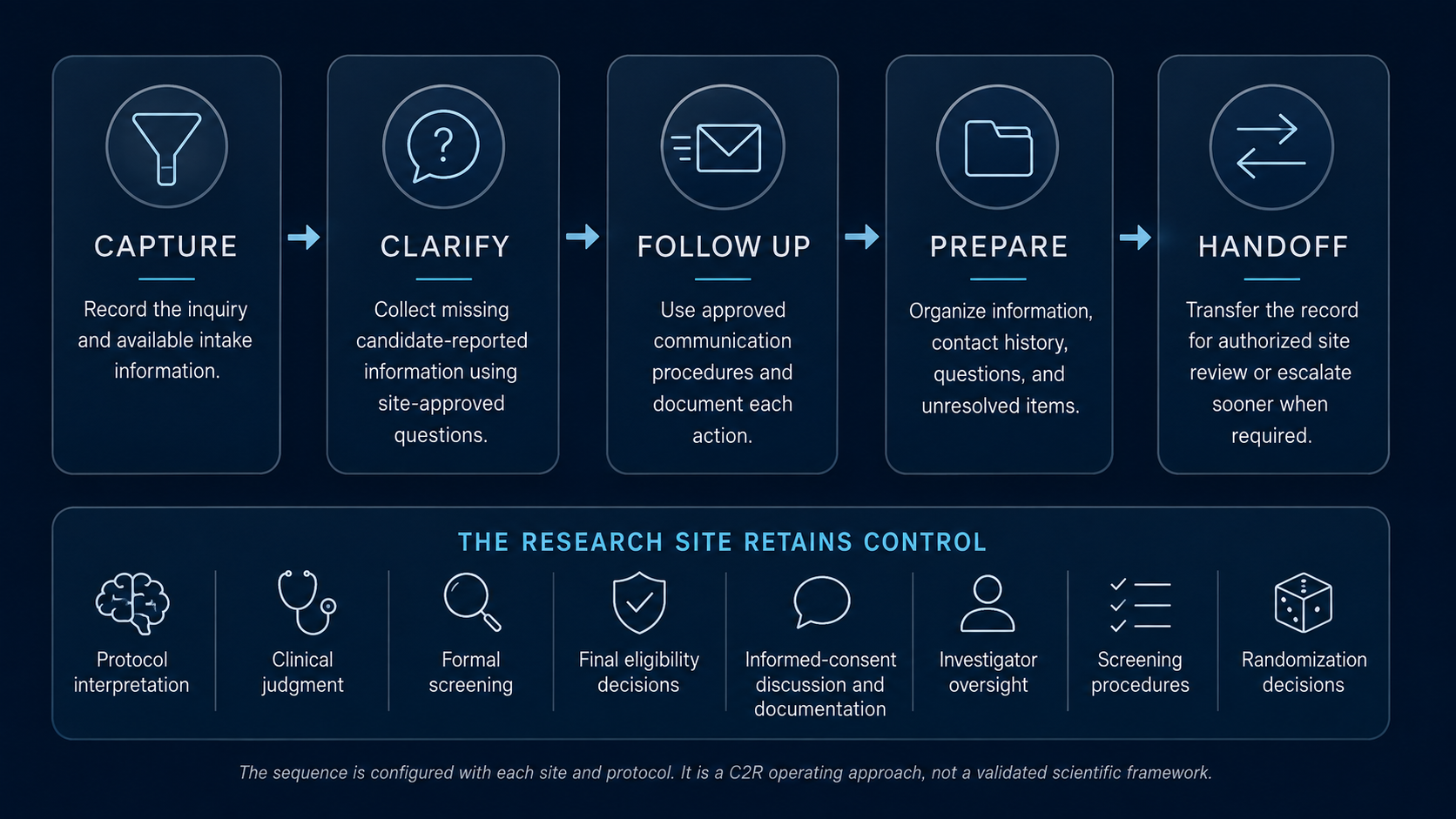
Consent2Randomize uses the operating sequence below to structure approved support. It is not presented as a validated scientific framework, and it is configured with each site for the protocol, responsibilities, permissions, and escalation requirements in scope.
Consent2Randomize may support preliminary prescreening within an authorized research-site workflow by using site-approved and, where applicable, IRB-approved questions, scripts, and criteria. This support may include documenting candidate-reported information, identifying apparent mismatches, tracking missing information, clarifying administrative details, and escalating unresolved clinical or protocol questions to authorized research-site personnel. Consent2Randomize does not independently interpret ambiguous protocol criteria, perform protocol-required clinical procedures, conduct informed consent, make final eligibility determinations, or replace investigator and research-site oversight.
What Remains Under Site Control
C2R's role stops at the approved operational boundary. The research site retains responsibility and authority for:
- Protocol interpretation
- Clinical judgment
- Formal screening
- Final eligibility decisions
- Informed-consent discussion and documentation
- Investigator oversight
- Screening procedures
- Randomization decisions
Audit One Prescreening Script Before You Scale It
Take one current intake or prescreening script and map every question to five fields: purpose, information source, approval or authorization, escalation trigger, and decision owner. Any item without a clear owner or approved boundary should be resolved before the workflow is delegated or scaled.
How to Measure the Preliminary Workflow Without Measuring Eligibility
There is no single universal benchmark that fits every protocol or site. Define each event consistently, establish a local baseline, and measure the operational work that occurs before site clinical review rather than treating eligibility rate as a C2R performance metric.
- Inquiry-to-ready-for-site-review time
- Start: referral or inquiry received. End: the record meets the site’s documented handoff-readiness criteria. Keep still-open records visible with their current age.
- Open-item rate at handoff
- Numerator: handed-off records with one or more unresolved nonclinical items. Denominator: all records handed off in the same defined cohort or period. Document exclusions.
- Post-handoff rework rate
- Numerator: handed-off records returned for missing candidate-reported or administrative information. Denominator: all handed-off records in the same period, using a defined rework rule.
- Age of unresolved pre-consent items
- Start when an item is documented as unresolved; end when it is resolved or the record closes. Report current age for items that remain open.
References
- [1]U.S. Food and Drug AdministrationInformed Consent Guidance for IRBs, Clinical Investigators, and SponsorsFinal guidance, August 2023.
- [2]U.S. Food and Drug AdministrationScreening Tests Prior to Study EnrollmentFinal information sheet, January 1998.
- [3]Office for Human Research Protections, U.S. Department of Health and Human ServicesInformed Consent FAQsOHRP notes that this guidance predates the 2018 Requirements and remains nonbinding general guidance unless a regulatory requirement is cited.
- [4]International Council for HarmonisationICH E6(R3) Guideline for Good Clinical PracticeStep 4 final guideline, January 6, 2025.
Sources and Further Reading
- U.S. Food and Drug AdministrationFDA guidance on screening tests before study enrollmentFinal FDA guidance explaining when screening tests may be appropriate before enrollment and the consent and IRB requirements that apply to clinical screening procedures.
- Electronic Code of Federal Regulations45 CFR 46.116(g) on screening, recruiting, or determining eligibilityFederal regulation describing conditions under which an IRB may approve screening or eligibility determination without informed consent.
- National Institutes of Health, Office of Human Subjects Research ProtectionsNIH guidance on pre-screening and screeningInstitutional guidance distinguishing pre-screening from protocol-defined screening and describing approved methods and minimum-information practices.
- CASRAICASRAI proposed definition of pre-screeningClinical-research terminology reference (Proposed v2026.1) describing pre-screening as an informal, preliminary assessment before protocol-defined formal screening.
Prescreening vs. Screening FAQ
These answers summarize the operational boundary discussed above. Study-specific requirements still depend on the protocol, site procedures, approvals, and applicable requirements.
Related Resources
Explore More Enrollment Topics
Continue Reading
Related Articles
If your team needs clearer ownership between preliminary prescreening and formal site screening, an Enrollment Alignment Call can map the current workflow, escalation points, and handoff standard without moving clinical decision-making outside the site.